EV charging guide
EV Charging in Pakistan: Home, Public and Connectors
An EV is easiest to own when you can charge safely where it normally parks. Before buying, confirm the car's AC and DC connector, your parking and meter situation, the installer's written load check, and at least one usable public backup.
Facts last checked: 8 September 2026
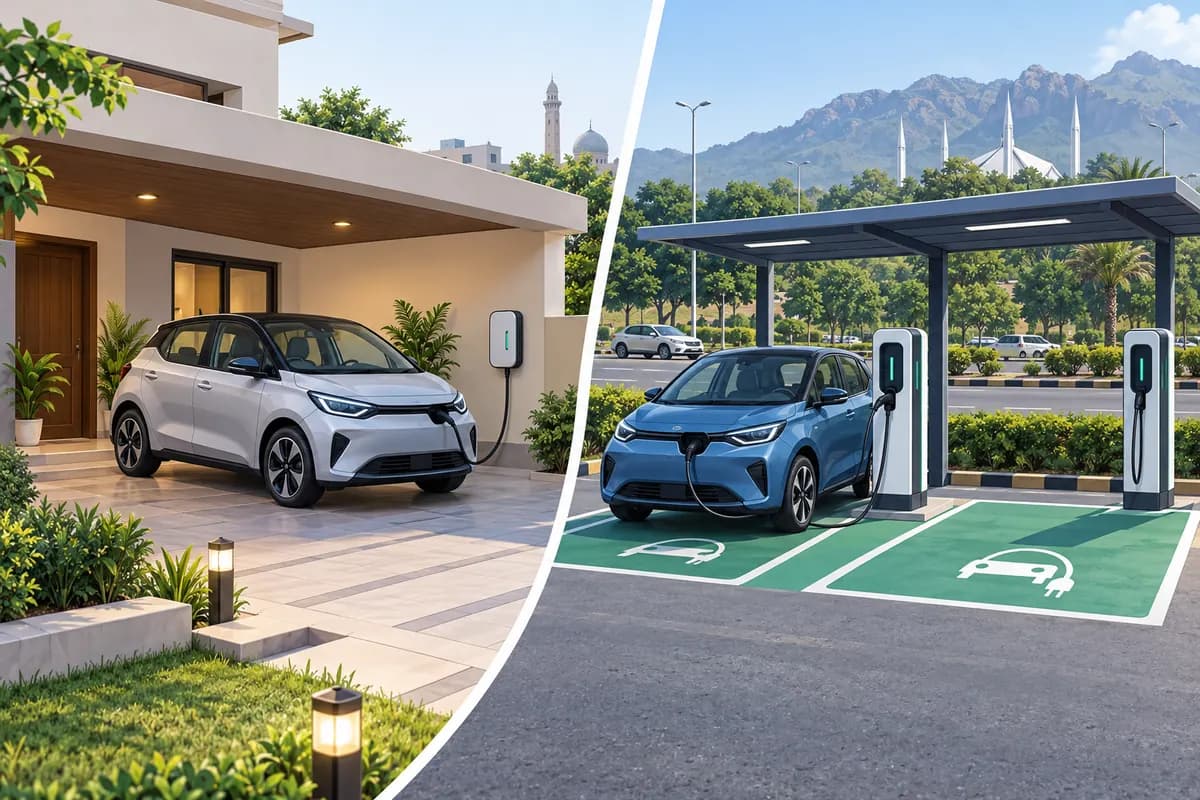
Two charging paths to verify
Home AC
- 1Parking and permission
- 2Professional load check
- 3Connector matched to car
Public DC
- 1Live status and access
- 2Price, fees and payment
- 3Primary and earlier backup
A physical fit is not enough. Verify the AC and DC standards separately in the vehicle manual and with the charger operator.
Recognise your car's charging inlet
Type 2 is AC; CCS2 is DC with an upper Type 2 section and two large lower contacts. GB/T AC and GB/T DC are separate inlets. CHAdeMO is another DC system. Match the exact car manual and station connector; similar shapes do not prove compatibility.


CCS2 · DC
DC uses the combined inlet. The upper Type 2 section also accepts compatible AC charging.
Source reference


Simplified identification only, not a wiring or adaptor guide. Contact sizes and housing details vary. Check the inlet label, owner's manual and exact charger; do not choose by appearance alone.
Charging in Pakistan: power and cost
Home supply
Pakistan's nominal supply is 230 V single-phase or 400 V between phases, at 50 Hz. Ask an installer to check your actual connection and available load. DC charging voltage depends on the car and station, not the household supply figure.
Charging speed
For example, Schneider EVlink Home lists 3.7 or 7.4 kW single-phase and 11 kW three-phase models. Your car's onboard charger and the installation can limit intake. A larger wallbox rating does not guarantee faster charging.
Power or energy?
kW tells you charging power. kWh tells you energy used: one electricity unit is one kWh. Voltage (V) is different. Compare a car's actual intake and a charger's compatible output, not voltage alone.
Cost per unit
At home, use the extra cost on your current bill, including slab or time-of-use changes and applicable charges. At a public station, check the driver's per-kWh price plus session, parking or idle fees. The operator's electricity supply tariff is not the driver's retail price.
Home charging should start with parking and load
First check whether the car can park beside your own safe electrical point. Apartment and rented-home users should get written permission before any fixed installation. Ask the installer to check the sanctioned load, meter, earthing, protection and cable route, then provide a written scope and price.
Use the vehicle maker's compatible charging equipment. Do not run a loose extension across a street, splice a plug, defeat protection or copy a social-media wiring diagram. Fixed EV charging is electrical work, not a DIY accessory.
AC and DC charging do different jobs
AC charging is usually the practical overnight choice. The wall unit supplies AC and the car's onboard charger sets the maximum intake. A larger wall-box number cannot make the car accept more than its own limit.
DC fast charging sends power more directly to the traction battery and is useful on longer trips. Speed normally changes with battery charge, temperature, the car and the station. The final part of a session may be slower, so plan time from a recent real session rather than the peak brochure number.
There is no safe universal connector claim
Pakistan has vehicles and chargers using more than one connector family. Common names include Type 2 for AC and CCS2, GB/T, CHAdeMO or other model-specific DC arrangements. A connector that looks similar may still use a different standard or communication setup.
- Photograph the vehicle inlet and read the owner's manual.
- Ask the seller which AC cable is included and test it.
- Confirm the exact DC connector on the operator's current listing.
- Do not depend on an unapproved adaptor for your normal route.
Check a public charger on the day of travel
A planned station or a registered operator is not proof that one plug is working now. Before leaving, check the operator's current status, opening hours, entry rules, connector, price, idle or parking fee and payment method. Keep an earlier backup on the route.
NEECA regulates public charging infrastructure in relevant DISCO and K-Electric service territories. Its registration portal and list are useful checks, but availability still needs confirmation from the operator. NEPRA's EVCS supply rate is also not necessarily the driver's final retail price because the service can include a market margin.
Official sources
Claims checked on 8 September 2026. Recheck operator status and prices before travel.
Shortlist for your real journey
After checking price, space, charging and route fit, browse the relevant AutoTrader.pk inventory.