
Used EV buyer guide
Used EV Battery Checks Before You Pay in Pakistan
Do not judge a used EV battery from dashboard range or one SOH number. Match the VIN and variant, get a fresh traceable battery report, verify local warranty and repairs, arrange a trained visual-only underbody check, and test normal charging and driving before payment.
Facts last checked: 8 September 2026
Evidence chain before payment
Identity
VIN, variant, mileage and certified capacity
Fresh report
Defined metric, tool, date and fault codes
Safe visual check
Pack shield, inlet, cables and flood signs
Charge and drive
AC, practical DC, SOC and warning state
Local decision
Warranty, invoices and written repair quote
Do not open a high-voltage battery. Stop charging or testing when flood exposure, leakage, a damaged cable or pack damage is suspected.
Start with identity and a traceable report
Match the VIN, exact variant, first registration, odometer, market of origin and certified usable battery capacity. Imported variants with similar names may have different packs, connectors or local support.
Ask an authorised dealer or competent EV specialist for a fresh report. It should show VIN, date, mileage, tool or software, battery charge and temperature, the named health metric and relevant high-voltage, battery-management or charging fault codes. An untraceable screenshot is weak evidence.
SOH and SOC are not the same
SOC is the energy available now, like a fuel gauge. A battery energy-health measure describes usable energy compared with a certified reference. UNECE notes that generic SOH is not measured or defined consistently across manufacturers, so two app percentages may not be comparable.
There is no universal buyer pass mark. A warranty threshold is not automatically a fair buying cutoff. Judge the defined metric, your route need, charging access, remaining locally valid warranty and a written repair risk together.
Inspect safely and look for flood risk
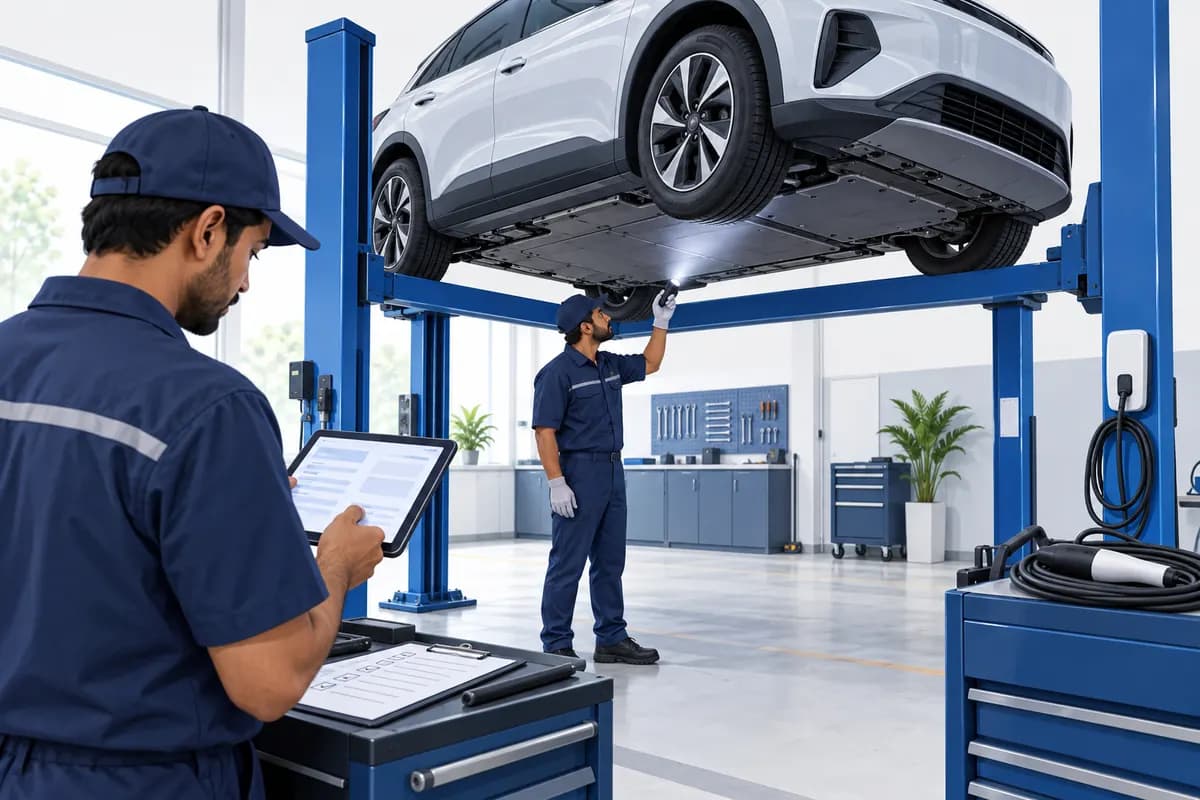
A trained person should visually inspect the pack shield, mounting points, charging inlet and visible high-voltage cables for dents, scrapes, cracks, missing fasteners, leaks or corrosion. This is a visual check only. High-voltage systems can cause fatal shock.
Look for mud or water lines, mildew, corrosion and unexplained trim replacement. If flood or high-voltage damage is suspected, stop. Do not charge or continue a road test; isolate the vehicle and use an authorised EV professional.
Test the full ownership journey
Confirm normal READY state with no high-voltage warning. Demonstrate a supported AC charge and, where practical, DC charging: plug communication, lock, start, stop and warning state. One slow DC session does not diagnose battery health because speed changes with charger, temperature and SOC.
On a representative drive, record start and end SOC, kilometres, displayed kWh per 100 km, HVAC and conditions. Watch for abrupt SOC drops, power limits or temperature warnings. Also test the separate 12-volt battery. Finally, check repair invoices, recalls and whether the exact warranty transfers and remains valid in Pakistan. Get a written local quote before negotiating any concern.
Safety and warranty sources
Guidance reviewed on 8 September 2026. Confirm terms for the exact VIN and model year.
Shortlist for your real journey
After checking price, space, charging and route fit, browse the relevant AutoTrader.pk inventory.